
miscellanea
|
Playa Guaney to Cayo Guillerm<< Playa Guana to Playa Guaney | Cuba2003 | Cayo Guillermo to Caibarien >> 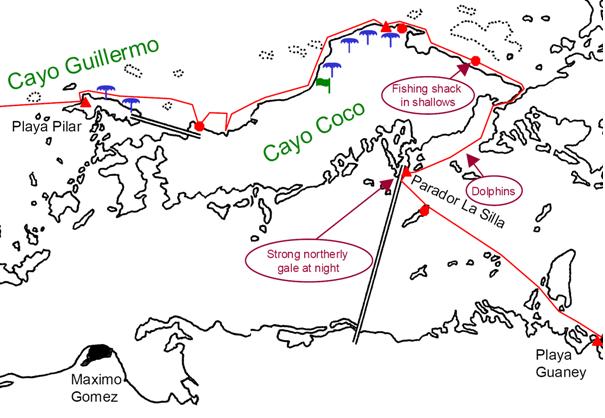 26 April. We set off at dawn again, waving adios to the caretaker and Playa Guaney, as we set off island-hopping diagonally across the lagoon. Our destination - the causeway restaurant Parador La Silla - was easy to find, being where the causeway ahead of us joined the large offshore island of Cayo Coco, one of Cuba's main tourist destinations. A stiff easterly breeze came up and chased us towards the parador, via a stop on an offshore cayo, until we could make out a tower there, and as we got closer people standing on top of it. They came down to greet us as we pulled up at the jetty there, where we left the boats to sit at the roadside cafe table for a most welcome fruit juice courtesy of our new Rombos hosts for the province of Ciego De Avila. Cuba is very provincial, with government and people alike very aware of provincial boundaries. After our Rombos friends left, the cafe owner took care of us (it was a Rombos cafe), and we had dinner and a beer or three there. A large iguana patrolled the cafe gardens, That night we got our first taste of the dreaded northerly gales, which sprang up fast after dark, violent winds with intense rain. We put up our tent inside the unfinished concrete room at the base of the tower, which unfortunately had no glass yet and the opening was towards the wind, so we stowed our gear at the far side as best we could to keep it dry, and enjoyed a night of little sleep. 27 April. By the morning the storm had passed, and we set off again, backtracking east to get around to the outside of Cayo Coco. Crossing the first, shallow lagoon we saw a small pod of dolphins jumping. The entranceway to the passage around Cayo Coco was unmarked and difficult to see from the low kayaks, as one sees only a solid wall of mangroves, and we had to take precise compass bearings to find it, although once in it widened out and was easy to follow. At one point there was a net set right across the wide channel, which we slid our kayaks over. The channel opened further as it turned north towards the road bridge and the open sea. A man was fishing from the rocks and shouted to me: he had lost his float which I retrieved for him. There was no boat traffic here so he was lucky that Cuba's only sea kayakers happened to be passing by. Our Rombos friends and the Guardia Frontera waved us through, and we carried on, as there was nowhere easy to land. The open sea was again a beautiful azure, and again there was no swell here inside the outer reef. The shore here was a low scrub and there was nowhere good to land, until eventually we came to an abandoned fisherman’s shack in the shallows way offshore. We moored the boats alongside and clambered up for shade, rest and lunch. Further west we passed outside a long mole harbouring a marina, the shiny infrastructure and vessels of this tourist area in stark contract to those we had seen in Cuba proper to date. The wind rose so we kept close to shore, which took us across the mouth of the bay Ensenada de Boutista, a mistake as it turned out, as the water inside the far point was so shallow that we had to walk, towing our kayaks behind us. Now we reached the sand beaches of the tourist resort area, with couples cavorting on the shore and on horseback. We stopped short of the first building by the first and only coconut palm, for a rest and to enjoy the relative tranquillity before arriving at the resorts themselves. I managed to pull down a green coconut using a hook on the end of the tent poles - a tricky manoeuvre in the trade winds - and we drank the refreshing milk. A couple of men came strolling along the beach, and (surprise, surprise) it is our Rombos friends looking for us. They told us where we were expected and that they'll be waving a tee-shirt for us, and wandered back down the beach. This was good advice, as it turned out, because once we were past the next curve in the coast there were resorts, crowds and little buildings dotted everywhere along. We hugged the coast, paddling through the swimmers and holiday makers, until the waving tee-shirt marked our destination, a charming little open Rombos cafe in the centre of a crescent beach, nestled just back into the low scrub. The welcome drink was most welcome. Again we chatted to our Rombos escort in their good English and our bad Spanish, and sampled the cafe's beer and food. The wind howled and there was heavy rain, as we sheltered in our tent on the sand under the eaves. 28 April. An unusually late start to let the weather settle and we were soon leaving the tourist resorts behind, although passing two more huge complexes under construction. An offshore wind rose briskly, so we paddled close in to shore rather than across the wide bay of Ensenada Puerto Coco. There was a shallow fringe reef along the coast here, and despite miles of trying I could not find an inside passage through it, so had to back out. We paddled in the deeper water just outside it, although even there we could still see the sandy bottom clearly with the see grass either side. It was like following an underwater yellow brick road. After a rest we crossed to Cayo Guillermo, paralleling the causeway a mile to our left. Cayo Guillermo too is a major tourist destination, and we paddled past more sandy beaches, shiny resorts and ramshackle jetties jutting out into the sea, and of course swarms of tourists. There were a few coconut palms along here, many more than on Cayo Coco itself. Towards the end of the resorts we saw our Rombos men waving at us, a welcome sight as Alison was exhausted, but it wasn’t to indicate our stop, but rather to wave us on to the next bay. The coast for a mile or two to the point was composed of rugged exposed rocks, low and vertical making them look further away than they actually were, and with many false points that raised then dashed hopes of an early finish. But finally we got to the real point and the large bay of Pilar Beach opened out to the left, the cafe just visible through binoculars on the far side. So Alison was an exhausted creature by the time we pulled ashore. This Rombos cafe at Playa Pilar was superb, the only building in the huge bay, overlooking the small island of Cayo Media Luna. The local television crew had been there earlier for and interview, but we took so long that they had given up on us. The cafe was closing - it mostly served lunchtime visitors from the resort that we had passed - but the cheerful fiercely pro-Castro owner (after our welcome drink - our first Rom de Cuba) cooked us a beautiful meal of fish, chicken, rice, potatoes, beans and fried plantains. This turned out to be the most delightful cafe we stayed in, although our wild beach campsites were of course even better. This marked also our fourth night in a row with cafe facilities: beer, excellent food and (some nights) showers, and our saying goodbye to those Rombos men, as we were about to leave their province. They had certainly made kayaking in Ciege De Avila province kayaking in style! << Playa Guana to Playa Guaney | Cuba2003 | Cayo Guillermo to Caibarien >> |


