
miscellanea
|
Playa Guana to Playa Guaney<< Nuevitas to Playa Guana | Cuba2003 | Playa Guaney to Cayo Guillermo >> 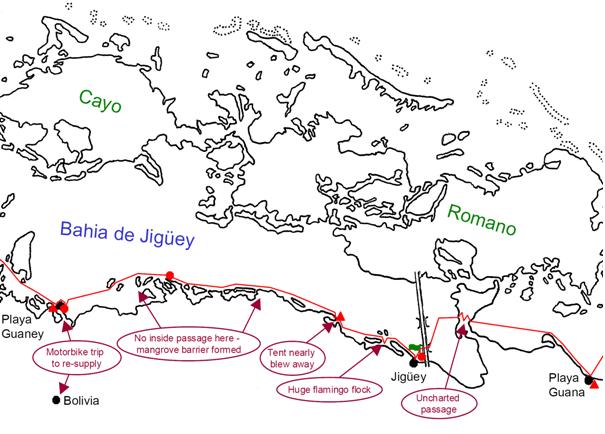 24 April. We think that the Guardia Frontera man stayed up all night to look after us. The Guardia Frontera were very concerned with our safety, much more so than us as all the Cubans were so friendly. He showed us the best place to launch our boat, and how to find the shortcut channel to the next lagoon: by the arch, we think he said, but our Spanish was very limited. We paddled along the coast to the intermediate point where we rested, and on a compass bearing to the channel, aiming slightly South so we knew which way to turn to find it. Sure enough the channel was marked by an arch of posts, and disappeared into the mangroves. We followed the drift of the current, and the direction of the sea grass where channels merged, until we emerged into Bahia de Jiguey. The first causeway from the mainland to the outer cayos crossed in front of us, a stone-ramp causeway with occasional bridges and even more occasional traffic. Another very shallow lagoon, that we had to almost cross before it was deep enough to leave the channel and head towards the village of Jiguey just west of where the causeway left the mainland. The Guardia Frontera post was at the end of the bridge, but two guards drove out along the causeway on a tractor, so I landed under a bridge to check in. We paddled on to Jiguey, again the scores of buildings and parasols causing dreams of beer and food, before we got close enough to see the reality of another deserted and derelict village. I was beginning to understand what El Comodoro meant when he questioned how we would get food and water en route. I had never imaged that all the villages marked on the maps along the coast would be so abandoned. It was baking hot in the tropical midday sun. Luckily and to our delight a local family - one of the last remaining - invited us to a delicious sit-down meal of black beans and rice with fish and fried plantains. Some of the guards joined the group, but the meal was only provided for us. They gave us drinking water too which they kept in plastic bottles in the freezer, so it took time even in that heat to melt it to our into out water containers. We offered the mother money for the meal, which she reluctantly took. One problem as a visitor in a country with two economies, dollar and peso, is one has no idea what is a fair price to pay: did we pay an insulting small or an embarrassingly large amount? We don't know. They invited us to stay in the village, but there was still plenty of daylight left and the wind had dropped, so we paddled on to look for a good camping beach. The shore here has an outer barrier of mangroves that are gradually joining up as a sand bank, forming shallow lagoons inside. In one such lagoon, where the barrier had a long gap in it, we saw a huge flock of flamingos, so huge that Alison thought at first it was a good camping beach, albeit a rather pink one. Beautiful creatures. We camped at the end of the next spit, on the point so that the breeze would keep the mosquitoes away, which it did, but almost blew the tent away too. 25 April. We started early as always to make the most of the cool and wind-free morning. The mangrove fringe continued along this coast, a narrow line of mangroves that had formed a long, thin sandbank that prevented us accessing the lagoons behind it. We stopped for lunch and cigar at one small break, leaving our boats floating tied to a large tree stump. It was baking hot. The protected and interspersed shallow lagoons continued along the mainland coast, until they opened up to the bay around Playa Guaney. We headed toward the town, enjoying a brisk tail wind. As we approached the town we saw a small port on the east side, although what looked like a yacht mast turned out to be the antenna tower of the Guardia Frontera post. A small, open, solid, antique green launch was approaching. Two bored Guardia Frontera in green fatigues lounged on the low cabin roof. The launch was towing four unpowered fishing boats in a line, each with fisherman aboard. They had been towed out to their fishing spots and were being towed back in again. I caught a ride on their wake into the small port, where we pulled ashore amongst a dozen boats and a hive of activity, the first working port we had seen since Nuevitas. The port was fenced off from the town with a solid gate. We were politely told that we couldn’t stay there and would have to continue on, bad news as it was a perfect landing beach and the rest of the town looked less inviting in that regard. It was obviously a tightly controlled area. So we paddled back into the wind and along the town’s foreshore, looking for a place to land. The town was huge but, as we were becoming accustomed to, largely abandoned. The only movement was from a couple of trucks, presumably transporting the catch. The only place we could find to land was in an abandoned holiday camp at the west end of town. Alison landed there while I explored further around into the inlet, where a smiling family were living with their pigs and dogs in a small shack. The dogs chased me back to where Alison had made contact with the caretaker of the holiday camp. We pulled up under the ubiquitous rusty parasols and sheltered from the afternoon sun. A small crowd of the caretaker’s friends gathered around as we showed them the kayaks and our navigation equipment, namely maps and compass. We discovered that the town used to be thousands of people, and now about twenty families lived there, with no shop or services. The holiday camp was used by locals in the summer, but now over the winter was virtually unused. It was fenced off from the rest of town. At least we could enjoy the luxury of a fresh water shower there. We explained that we needed supplies, and one of the men there arranged to take me into the inland town of Bolivia on his motorbike. He went off to arrange transit with the Guardia Frontera, and an hour later we were on our way down the causeway, waving at the guard post as we left town, and passing the trucks or tractor-towed trailers carrying the fisherman and workers to and from the port. Bolivia is a beautiful, leafy town laid out around a central square of grass and huge trees. The shop was closed, but eventually my escort convinced them to open up. This was a dollar shop in what was clearly a peso town, carrying all the imported goods. I stocked up with tinned food and some cold beer for ourselves and caretaker, which was warm beer by the time we got back. The shop had no bread, so we rode around town again to find a baker, who had no supplies left but bags of cabin biscuits, so I bought a couple of packets of them. Back at the camp, Alison had set out all our gear to dry and was chatting with my escort’s girlfriend. While I was away she had spent time also with the caretaker's crazy wife who unfortunately - as I feel an affinity for crazy people - I did not get to meet. The caretaker invited us to dinner, which he cooked at dusk on a little charcoal brazier that he set up on the veranda, the usual and delicious black beans and rice, plus the luxury of fried eggs. We ate in his tiny kitchen. The mosquitoes were terrible, although at least Alison and I had mosquito repellent, while the locals had to suffer their daily evening dose. Again, we think he stayed up all night to guard us, more worried than we were about our safety. The palms along the shore rustled in the wind and the moon chased their shadows around the sands. << Nuevitas to Playa Guana | Cuba2003 | Playa Guaney to Cayo Guillermo >> |


