
miscellanea
|
Caibarien to Isabela de Sagua<< Cayo Guillermo to Caibarien | Cuba2003 | Isabela De Sagua to Playa el Salto y Ganuza >> 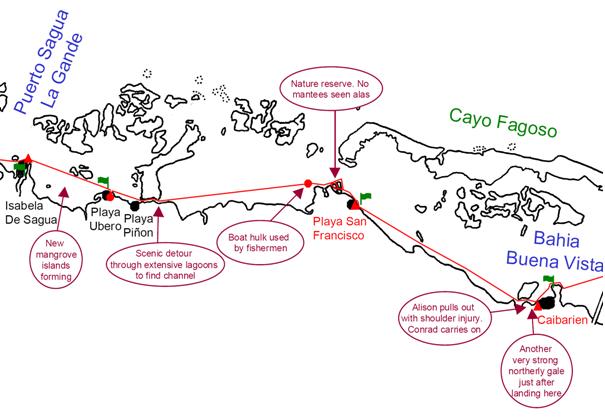 2 May. In the morning Alison wisely decided that her arm was too sore and needed a day or three’s rest. Ten day’s continuous kayaking to a tight schedule has taken its toll. We made a sling for her from the boat bags, and took her folding boat apart. Rombos kindly came to her rescue and offered to drive her to the next rendezvous, a great help as it would be possible but very difficult by public transport, with one arm and a heavy boat. So I set off late in the morning towards Playa San Francisco. I cut inside the island just west of Caibarien, narrowly escaping grief as the current whisked me through the sharp spikes of a half-collapsed barrier of old railway tracks. I made fast time with a following breeze, contouring the coast a mile off, and in no time was approaching Playa San Francisco. The Guardia Frontera officer met me on the jetty and it took all my Spanish to explain why I has alone and about Alison’s arm. But eventually that was done and I was guided into the small boat harbour, unloading in the mud between a rickety jetty and a sunk, decaying dinghy. Above me the square monolith of the Guardia Frontera post loomed. Pigs snuffled around the bare earth inside the perimeter fence. I carried the bags of equipment and boat ashore. Everywhere was muddy, so I pitched the tent on the driest patch right against the perimeter fence, after clearing it of broken glass and nails. I soon discovered that the fence had holes in it and the pigs were free to roam, which they did around my tent. I sat in a tractor for shelter from sun and rain, and cooked there too for shelter from the pigs. A walk around the town of Playa San Francisco revealed a small grid of dilapidated wooden houses on flat, wet ground. Pigs, cats and dogs roamed the streets. The shore beyond the Guardia Frontera post was occupied with the ubiquitous abandoned holiday camp, where a couple of bored teenagers hung out. Playa San Francisco was the only place in Cuba that I visited that had a pervading air of depression, and the only one I was keen to depart early from. 3 May. Playa San Fransicso did have a faded, wooden notice on the shore advertising a Manatee museum, which I never found. Soon after leaving the Playa I turned through some island channels both as short-cut around the point and to explore them in their own right. At the central junction of the channels I found a sign noting that this was a Mantee Scientific Reserve. I had never seen a Mantee, so I spent the next hour exploring all the many channels looking for sign, but alas nothing. Carrying on westward I pulled up against a grounded hulk of an old fishing boat, which was home to two young fishermen. They tried to point out to me the channel through the base of the next mangrove peninsula, but it was too far away to see anything but a low, continuous green barrier. I waved farewell and headed towards it. The channel was easy to find and I was soon through the mangrove belt and passing the small town of Playa Pinon to the left, a quiet, deserted town of square houses nestled close to a jetty. I could already see the next town of Playa Uvera a couple of miles down the coast, a livelier town with families playing in the water on improvised rafts, and kids playing hide and seek amongst the buildings on the foreshore. Negotiating the old palings that studded the shallows I pulled ashore to a greeting from a pleasant, round-faced Guardia Frontera officer and two guardsmen. The latter looks after my boat that I left tethered to the jetty, to keep it from scraping on the rusty iron supports. The officer asked my for my passport and invited my to his small office, the telephone inside a padlocked, made-to-measure wooden box. He unlocked it and called base, and all was well. Back at the jetty I wanted to have lunch, but it was simply too difficult with the soldiers holding the kayak ready for me to get back in, so I did and left hungry. I could practically see the town of Isabella de Sagua nearly fifteen kilometres across the Bahia, but navigation was still difficult. Here new mangrove islands were forming in the shallows, some just tiny patches of sticks with three leaves apiece, invisible until you were onto them, others an impenetrable cluster of bushes, and none of them on the map. The maps had been good until now but became increasingly poor in shallow areas of the western archipelago, where new mangrove growth abounded and many passages were becoming choked. Approaching the town of Isabella de Sagua, at the mouth of the river Sagua la Grande, it was not at all clear where to land to meet up with Alison and Rombos. I floated offshore, drifting in the current, searching for a waving hand to indicate where to land, but saw nothing, not even from two cafes that looked likely candidates. I paddled around the headland and into what turned out to be the industrial side of town, landing on a small beach encrusted with the debris of long collapsed jetties. Goats wondered around the abandoned lot, and rows of new, character-less concrete flats lay between me and town. I arrived on the main street wondering where to start my search, when a minibus pulled up with smiling Alison and the Rombos men. We were based in the shark cafe, one of the ones that I’d passed, so I paddled back to it. So passed another night of luxury eating, drinking and camping in the open cafe. << Cayo Guillermo to Caibarien | Cuba2003 | Isabela De Sagua to Playa el Salto y Ganuza >> |


